
Our recent post about Roddy Frame took me down into a rabbit hole that led, eventually to Tony Mansfield, the songwriter and producer who played a small and largely forgotten role in the Aztec Camera story. But about whom details are a bit scant.
I first came across Tony because of his band, New Musik, one of the more curious footnotes to the poppier end of the new wave story. And whose signature pop songs – like those of Martha And The Muffins, The Vapors and The Lotus Eaters – detonated without warning from our three-in-ones during those years when we were trying to determine the differences between good, bad and ugly. Decades later I’m still unable to fully shake ‘Echo Beach, ‘Turning Japanese’ and ‘The First Picture Of You’, the most pressing, gold-plated bangers of the period. Indeed, I can still recite the lyrics to Cliff Richard’s ‘Wired For Sound’ even though I often struggle to remember my daughters’ middle-names.
New Musik was Tony’s band, more or less, and it’s hard to think of them as anything other than a group of session players, at their most comfortable within the studio walls, who fell into the one groove and released a run of excellent, synth-built pop singles as the 1970s cross-faded into the 80s. ‘Straight Lines’, ‘Living By Numbers’, ‘This World Of Water’ and ‘On Islands’ are easily the pick of them and turn up now, the very odd time, on those BBC4 re-runs of vintage ‘Top Of The Tops’. And on which New Musik are perennially stuck just outside of the Top Thirty, forever bubbling under.
The spelling of the band name isn’t the only thing that dates them. In the most primal traditions of popular music, they defined the moment – or certainly took a reckless enough swing at it – in their coloured blazers, geeky specs, cute bow ties and with their battery of electronic kit. And like most others from that period, Kate Bush, Blondie and Buzzcocks excepted, they look faintly ridiculous with it. In most of the on-line clips pirated from various television archives – and there isn’t a huge amount – keyboard player, Clive Gates, in his horned rims and hunched over the plate of tits and knobs on his Prophet synth, looks like a skinny Frankenstein hooked up to a mind-altering device.
Out front, centre-mid, Mansfield himself looks like Frankie Gavin from De Danann in an out-sized pair of Clark Kent’s glimmers while the well-assembled, bearded bassist, Tony Hibbert preferred the more minimal, barely breathing look – another pose du jour – that, on one television archive clip, has him miming his basslines with one hand clung inside the pocket of his trousers. With an excellent drummer, Phil Towner, completing their number, the eventual New Musik line-up reads like the spine of a typical Ipswich Town line-up during their pomp years under the late Bobby Robson from 1980 until 1982.
New Musik’s sound – layered synthetic keyboard lines and toothsome vocal harmonies spooned over old school acoustic foundations – has dated better than their look, just about. Although they never enjoyed the same level of success as some of their peers – Buggles, Naked Eyes and A Flock of Seagulls loosely fit the same bill although all of them were far more defined and rounded – that string of singles certainly cut a dash. And created, for their writer, a spring-board from where Mansfield launched a career as a fine pop producer with good ears. ‘Such a digital lifetime’, he sang on ‘Living By Numbers’, the band’s biggest-selling single even if, in reality, New Musik’s best known material has more in common with Owen Paul’s version of Marshall Crenshaw’s ‘My Favourite Waste Of Time’ than with the ground-shifting European electronica of Can and Kraftwerk.
With my own radar starting to locate regular targets, I took to New Musik with the same gusto as I did the likes of Adam and the Ants, Gary Numan, John Foxx and Squeeze. To the extent that 1978 is defined, for me, by Charlie McCarthy’s speech after Cork won the All-Ireland hurling final win and Pete Shelley’s last vocal line on Buzzcocks’ ‘What Do I Get’.
New Musik looked as other-worldly as they sounded on my over-worked three-in-one: even within the pages of Smash Hits they seemed to forever occupy the hard shoulder, and this only added to their lustre. [We know now, of course, that New Musik didn’t just spring up over-night. Three of them had been involved with The Nick Straker Band who, marching in tandem, enjoyed a 1980 hit single with ‘A Walk In The Park’. While Phil Towner had played the drum parts on Buggles’ imperious ‘Video Killed The Radio Star’].
New Musik released three albums in all but their best known songs appear on their fine debut, ‘From A To B’. ‘Anywhere’ [1981] is the bridge to their final, and easily most interesting elpee, ‘Warp’, a far more tech-skewed record, featuring a clutch of instrumentals and released in 1983. By which stage Towner and Hibbert were gone and Mansfield was basically directing the operation from behind a Fairlight synthesiser.
The earliest Fairlight* was an extravagant, pricey and unquestionably game-changing piece of digital technology that enabled users to ‘sample’ or record acoustic sounds [instruments, vocals and percussion] – rather than electronically ‘synthesise’ them – and then play these back at different pitches.
Its first iteration came onto the market at the same time that New Musik were getting their act together. Subsequent versions featured sequencing and workstation capabilities, offering revolutionary sound palettes that were quickly embraced by many of those more comfortable working on their own or in more considered surrounds, off the road. Peter Gabriel, Kate Bush, Buggles [there’s a sub-plot emerging here, isn’t there?] and Thomas Dolby were primary among them, taken by the potential and the self-sufficiency that came with what was an unwieldly piece of kit.
Tony Mansfield was another of those early adapters and his fondness for, and proficiency with the Fairlight can be heard, not just on New Musik’s material but on the many subsequent production projects he took on after the curtain fell on his band following the release of the ‘Warp’ elpee in 1983. And nowhere more so than on Aztec Camera’s ‘Walk Out To Winter’, which he re-recorded and produced later that same year.
The original version of ‘Walk Out To Winter’ appears on Aztec Camera’s debut album, ‘High Land, Hard Rain’, and was produced by Bernie Clarke and John Brand. Brand followed a pretty standard career trajectory and worked first as a jobbing studio engineer on sessions with the likes of XTC and Magazine before going on to produce The Waterboys’ ‘A Pagan Place’ and The Go-Betweens’ ‘Before Hollywood’ elpees. Himself and Clarke, a keyboard player and arranger who also features on a couple of those earlier Go-Betweens albums, certainly succeeded in nailing the raw confidence in that early collection of Aztec Camera songs even if, as can often be the case with first albums, some of the excellent material sounded callow enough once it was committed to wax.
During the decades of insanity when the music industry was awash with more money and cocaine than cop-on, the recording process could often be grotesque, unbelievable, bizarre and unregulated. Far too many records, especially those pitched at the higher end of the commercial market, went through scores of executives, marketing heads and assorted flunkeys who would often insist on priority material being re-visited, re-mixed and re-recorded. Often for legitimate, quality-related reasons and often not.
The Smiths’ debut album, also recorded in 1983 for the Rough Trade label, was famously re-recorded from scratch and, even after the band switched producers – John Porter for Troy Tate – the album still managed to sound hollow and far more underwhelming than the band sounded on their first singles or live in concert. Closer to home, The Frank And Walters’ ‘After All’ and the sweeping ‘This Is Not A Song’ were both re-recorded after the Edwyn Collins-produced originals were deemed, rightly in my view, to lack the sparkle and urgency of the band’s earlier material.
The initial, Pearse Gilmore-produced sessions for the first Cranberries album were scrapped and, after a trial period with Stephen Street, the project was eventually re-started from the floor up. The making of the second An Emotional Fish album, ‘Junk Puppets’, was another protracted affair that went through numerous hands, locations and producers and, invariably, cost an arm and a leg. The final cut was produced by Alan Moulder [the brooding, guitar-heavy parts] and Clive Langer [the more up-beat, instant parts], while David Stewart was later enlisted to add confetti canons and balloon drops to a couple of key cuts on what is, to my mind, a formidable and largely under-rated album.
It’s Tony Mansfield’s version of ‘Walk Out To Winter’ with which most of you will be familiar, even if the single failed to do the chart business expected of it and the band remained on the margins until the re-issue of the breezy ‘Oblivious’ towards the end of 1983. And it’s a version that, as you’d expect, has long divided opinion among Aztec Camera watchers, many of whom have stayed steadfast to the tender opening strum of the original.
The primary differences between the two versions are in the first four bars, where Mansfield adds a distinctive intro, and the broader Fairlight-derived scaffolding he uses to bolster the foundations throughout, devices familiar to fans of New Musik, where they were used liberally. These bespoke sounds, touches and finishes can also be heard, in variously evolved form, across most of the subsequent production work Tony over-saw after New Musik folded. Most notably The B52s’ album, ‘Bouncing Off The Satellites’ [1986], Naked Eyes’ cover of the Bacharach and David number, ‘[There’s] Always Something There To Remind Me’ and Captain Sensible’s ‘Glad It’s All Over’, which he co-wrote and which charted in 1984.
But as a producer, Mansfield is probably best known for his contribution to the first A-ha elpee, ‘Hunting High And Low’, which was recorded in Pete Townsend’s Eel Pie Studio in Twickenham in 1984. The Norwegian band had relocated to London the previous year, from where they became one of the great, defining pop groups of that decade, selling over eleven million copies of their debut album. And although he takes a producer’s credit on nine of the cuts on ‘Hunting High And Low’, the relationship between the producer and the band – or perhaps the record company? – wasn’t a wholly positive one and, after six weeks, he was off the job. But only after he’d taken an early stab at the song that would later become A-ha’s breakthrough single, ‘Take On Me’.
The song was subsequently re-recorded by Alan Tarney and, supported by a distinctive, semi-animated promotional video, gave the band its first chart success. Tarney, a noted songwriter and musician – he was a member of The Shadows at one point during the 1970s – had written and produced Cliff Richard’s ‘We Don’t Talk Anymore’ and, in several key respects, was cut from the same cloth as Tony Mansfield. ‘Wrapped in warm synths, propelled by shiny hard guitar, hits like ‘Take On Me’ and Cliff Richard’s ‘Wired For Sound’ are the essence of the Alan Tarney sound’, wrote Saint Etienne’s Bob Stanley as part of a Guardian feature piece in 2015. And he’d have known better than anyone; – Tarney produced ‘You’re In a Bad Way’ for Stanley’s group, Saint Etienne, over twenty years previously.
In an interview with ‘Sound On Sound’ magazine in March, 2011, Tarney, who also co-wrote and produced Cliff’s imperious ‘Wired For Sound’ and later sprinkled the glitter on terrific pop songs by the likes of Dream Academy, Barbara Dickson, Squeeze, Bow Wow Wow and Pulp – told Richard Buskin that ‘the Tony Mansfield version [of ‘Take On Me’] employed a Fairlight and it just didn’t sound like A-ha at all’. ‘All I did was recreate the original demo. Its ingredients were good – nothing was really wrong other than it just didn’t quite sound like a finished record’.
And, he continued: ‘I actually worked with Tony on another project, so I knew what to expect. At that time he was totally a Fairlight man and I can imagine why Warners [A-ha’s record company] felt his version wasn’t quite right’.
‘Hunting High And Low’ went on to break A-ha worldwide and Alan Tarney was back on duty with them on their next two albums, ‘Scoundrel Days’ and ‘Stay On These Roads’. They never worked with Tony Mansfield again.
*My thanks, as usual, to one of my own favourite producers, Chris O’Brien, who I besiege with technical and sound queries and who, in this instance, put me right about the Fairlight. And without whom etc …
APPENDIX
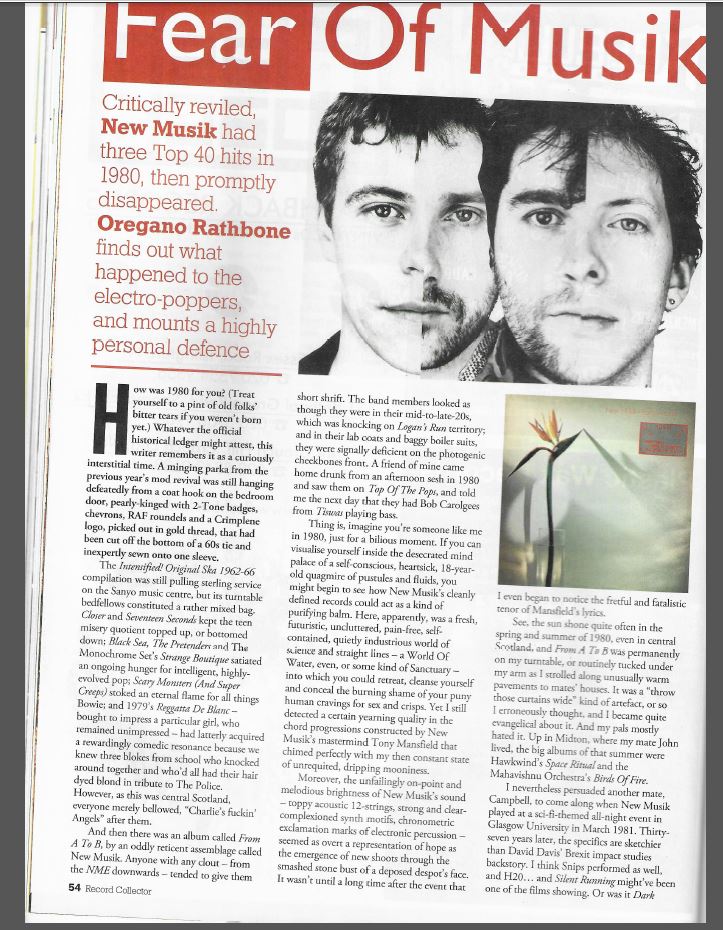
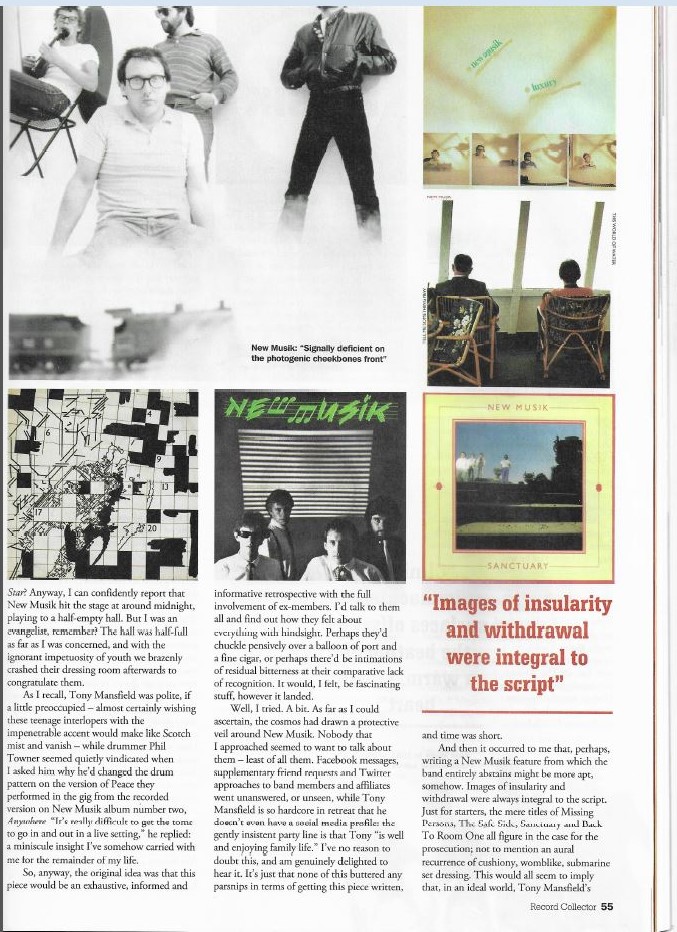
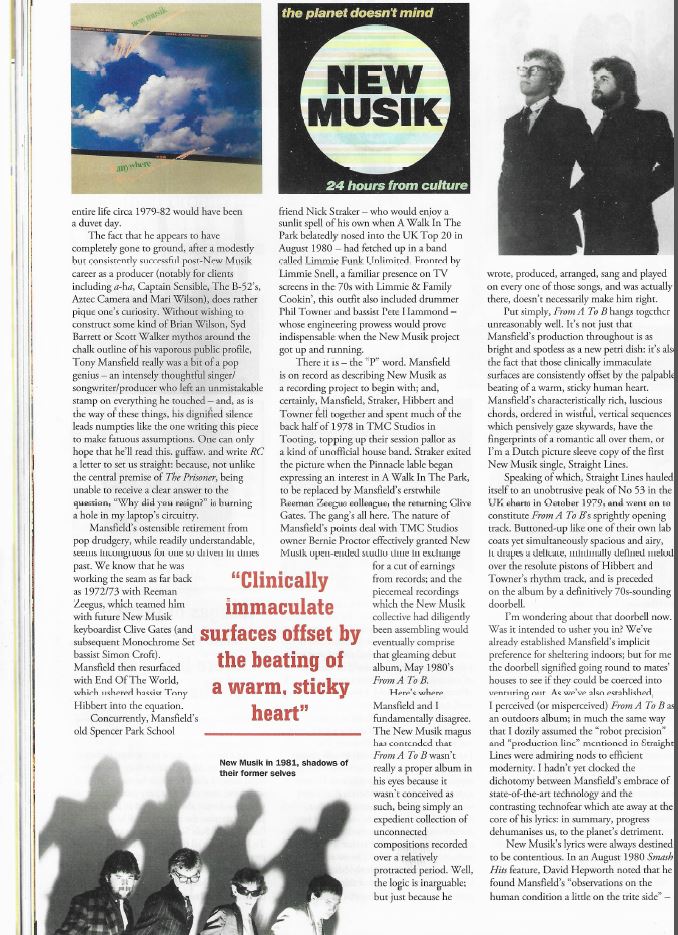
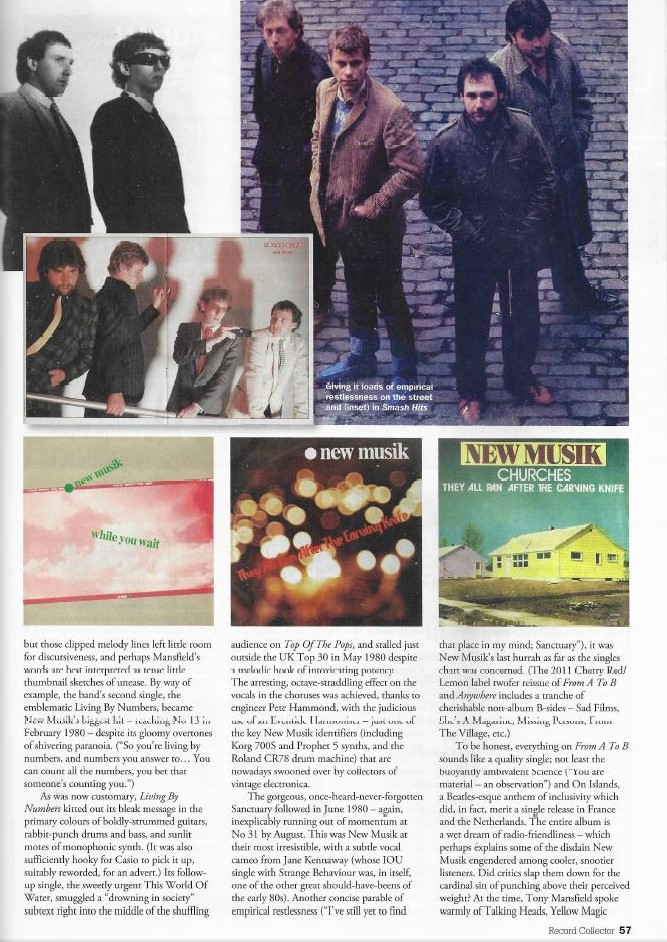
We received a number of comments on this piece. One comment came from John Dundon who mentioned having come across a great article in Record Collector. He dug it out, scanned it and sent on. We now share that here. If you enjoyed our piece, you should really enjoy this piece. Thanks John…
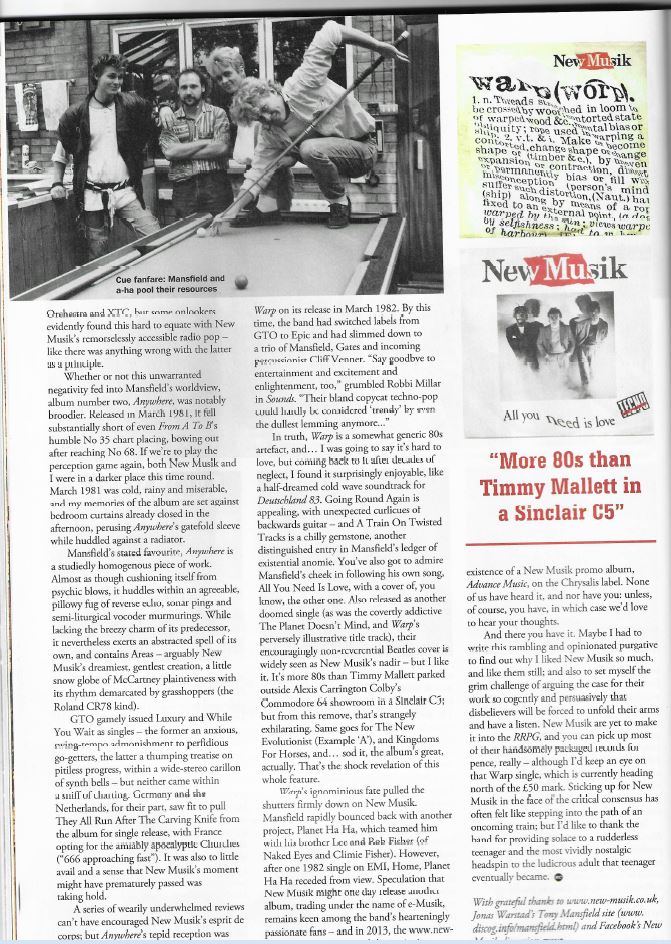


 The Blackpool Sentinel
Excellent piece Colm. Sorry to be a trainspotter but just a couple of minor correcions if I may…Firstly, The Smiths’ debut LP, though recorded (and re-recorded) in 1983, was actually released in 1984 (February ’84 to be precise). As an aside, I actually love John Porter’s production, dated-sounding embellishments and all, although I know I’m in a minority there.
Secondly, in this section you typed “wrote Saint Etienne’s Bob Stanley as part of a Guardian feature piece in 2015. And he’d have known better than anyone; – Tarney produced ‘You’re In a Bad Way’ for Stanley’s group, Saint Etienne, a decade previously”. Again sorry for my trainspotter tendencies but You’re in a Bad Way was actually released in 1993, making it 22 years prior to Bob Stanley’s Guardian piece on Alan Tarney.
Otherwise, a terrific and insightful read for us pop-pickers as always. Ta.
x
Keeley
LikeLike
Thanks v much, Keeley. And of course you’re correct : happy to amend. I think that the Cliff Richard stuff just blew a couple of my fuses. Hope all is well with you and thanks for staying with us. All the best. Colm
LikeLiked by 1 person
You’re most welcome, thanks Colm. Lol re: Cliff. That said, are you familiar with a single he released in the late 1970s called ‘Green Light’? It is earth-shatteringly good! I first came across it in 2005 while listening to BBC Radio 2, the only time I’ve heard it aired anywhere. Ordinarily I wouldn’t be his biggest fan but that song (and the mighty We Don’t Talk Anymore) are superb. PS Thanks for sharing Part 21 of my Inga blog. Best, Keeley
LikeLike
One of the breakthrough Into Paradise songs was ‘Red Light’ and I used to half-jokingly suggest it was a sister piece to the Cliff song. I’m fascinated by Alan Tarney. Who also wrote ‘Some People’ for Cliff, although that was four or five years later. All the best, Colm.
LikeLiked by 1 person
Pretty sure I read a sizeable featurev a few months ago in Record Collector about New Musik
Can have a root for it and perhaps scan it to you if of interest
LikeLike
Hi John. Many thanks. Would love to see that if it isn’t too much bother. All the best, Colm.
LikeLike
Found that article on New Music
Send me email with best address and I ll scan it to you tomorrow
LikeLike
hi John. That’s brilliant. You can email us at theblackpoolsentinel@gmail.com
LikeLike
Hi COLM
Sent that article by email / did it land ?
LikeLike
This is brilliantly written article. Thanks.
LikeLike
Thanks for reading, Pete. Glad you enjoyed it.
LikeLike