The Blackpool Sentinel was delighted to be asked to contribute to The Irish Independent’s recent attempt to name the fifty best Irish albums of all time. Ambitious projects about music and records are food-and-drink to those of us in the anorak classes, even if lists of this kind inevitably raise more questions than they answer. Usually from those even crankier and older than ourselves.
For starters, there’s no such thing as Ireland’s best album: how could there be? And neither, in respect of such a complicated space as that inhabited by popular culture, can any list claim to be truly definitive. All history is contestable, even that as trivial as the quality of Ireland’s recorded output over the last seventy years.
The breadth of the canvas on which these debates take place presents another familiar concern: context. Of, if you like, the first principles on which ratings and weightings are founded. With quality the preserve of the eyes and the ears that behold it, it’s a tricky enough ask. One for which you’re damned if you do and damned if you don’t.
For the purposes of the Independent piece, over fifty of us – ardent hunters, collectors, assorted chancers and liggers – were asked to submit the ten albums we considered to be Ireland’s best ever. After which our votes were tallied, parsed, and presented by an upstanding and unflappable Returning Officer, John Meagher, a fine writer and analyst himself. The final count, notwithstanding all the above, returned a selection that’s as balanced, wide, and considered as is possible to achieve under these conditions. The omissions are varied and notable enough to make the whole exercise debate-ready and I hope that those who pored over it enjoyed it as much as those of us who shaped it.
Lists of favourite records, like virtually all aspects of popular culture, are predicated and often defined by the moment. A point once made with typical brio by the radio presenter, Dave Fanning who, when asked to select his five favourite songs many years ago on a long-lost Radio 2 show, just ignored the theory and instead nominated the most memorable cuts that came into his head. Of which, ‘Downmarket’ by The Blades, The Undertones’ ‘Teenage Kicks’ and ‘Virginia Plain’ by Roxy Music were among those that magically appeared.
The biggest issue I encountered in trying to compile my own list was a most basic one: recalling some of the albums deemed qualifiable. Where, in other words, should I begin? Indeed, in the six weeks or so since I finally filed those choices, I’ve already changed my mind about several of them and, were I to begin the selection process again today, it wouldn’t be at the spot from which I initially set out.
There’s an inevitability to lists like these too, of course. Like a dominant football or hurling team, the core tends to select itself – battle-hardened, highly-decorated veterans are the most difficult to drop – and the real contest for spots tends to happen on the margins. Which means that when it comes to the search for Ireland’s best albums – whatever that means? – U2 will always figure largely, and rightly so. Their conditioning, size and profile ensures that the best-known domestic group of all-time will forever dominate any debate about popular music in modern Ireland. But that said, I’m not convinced that some of the band’s most venerated albums still cut critical muster like we maybe once thought they did. And maybe Van Morrison likewise?
But my fellow contributors to the Indo’s list clearly disagree with me, and both U2 and Van turned up as prominently as ever in the final shake-down. The list also included albums by Rory Gallagher, Thin Lizzy and a clatter of what we might term ‘duty selections.’ Records that many of us are unsure about but which, under the weight of history, maybe feel conscience-bound to incorporate.
Lists provide good, pacey copy and, beyond all else, a welcome distraction from the unremittingly grim cycle of news. But the Indo’s poll also demonstrates exactly how Irish popular culture has evolved – and continues to evolve – over time. That ground-breaking, home-produced elpees by Denise Chaila and The Rusangano Family now sit comfortably in a critical list alongside A House and The Undertones is one testament, a given at this stage. But that albums by Planxty and The Gloaming, Christy Moore, Mary Black, and Paul Brady are also regarded now – rightly or wrongly – in the same breath as Whipping Boy, The Immediate and Fight Like Apes indicates, to these ears, a shift that goes way deeper than any amount of numbers on a page.
The great festival line-ups at Carnsore, Lisdoonvarna, Castlebar and even Féile melded, from the late 1970s onwards, a variety of influences and booked a slew of performers from all arts and parts. But this creative catholicism – which was, again, of its time and in the moment – was generally regarded with suspicion. Away from the open plains, badly-hung marquees, and improvised sound-stages on some of the most far-flung corners of Ireland, the rock and traditional/folk caucuses – with honourable exception – rarely met. Nor were they encouraged to.
That powerful new groups like Lankum and gifted musicians like Cormac Begley can now proudly compound such disparate ranges of influence and form in the creation of vivid, urgent soundscapes, speaks to a growing cultural maturity. One that’s reflected clearly in the more interesting aspects of The Irish Independent’s final tally, where the distillation of carrots with lemons has never sounded sweeter.
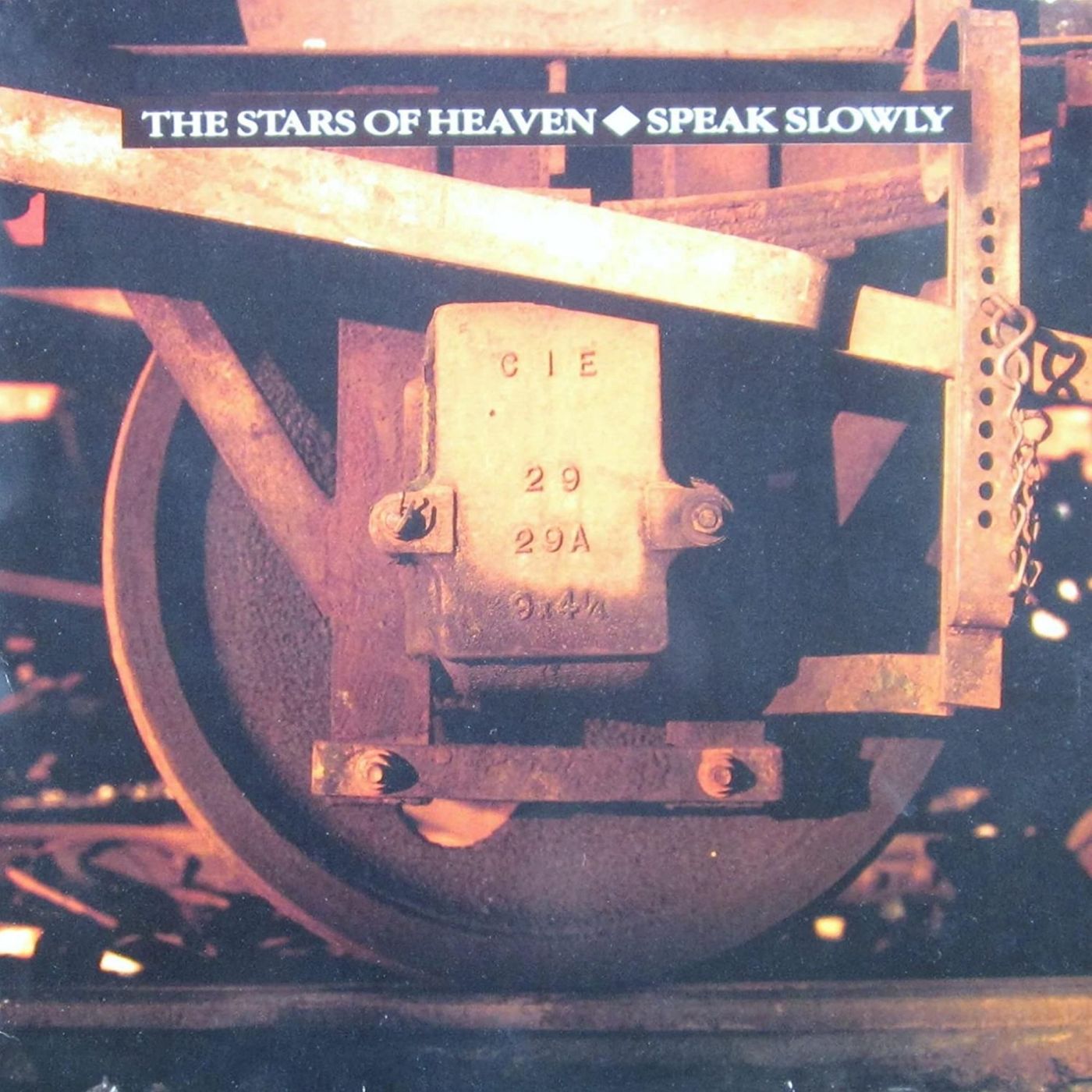
On a purely selfish level, I needed no encouragement to make the case once again for The Stars of Heaven’s ‘Speak Slowly’ album, one of many fine Irish records lost over time to the vagaries of the marketplace and the public palate. First released in 1988 on the Rough Trade label, it was returned as Ireland’s 38th best album of all time by The Irish Independent, which seems apt. ‘Speak Slowly’ is yet another terrific domestic issue that, even now, sounds far more than the sum of its many parts but that’s destined to forever reside in the margins, a footnote in the histories of independent-facing music in modern Ireland.
I’ve written at length about The Stars here – they’ve long been one of my favourite groups – and we’re not going to re-cycle familiar old theories again now. Suffice to say that, with a broad span of reference, a beautiful lyrical flourish and instinctive writing sensibilities, the band produced a series of quietly remarkable records during its lifetime, of which ‘Speak Slowly’ is the most cohesive.
One of the group’s two principal songwriters, Stan Erraught, made the move from rock ‘n’ roll to academia a number of years ago and is currently based at the University of Leeds, where he specialises in music and aesthetics. As a keen scholar of Irish popular culture, he’ll be only too aware of The Freshmen, one of the outlying groups that emerged from the Irish showband circus during the 1960s.
Formed in Ballymena in County Antrim, The Freshmen were set apart from their peers on the ballroom circuit by virtue of their creative restlessness and, in later years, their candour. Fronted by Derek Dean, and featuring a core of obscenely talented musicians – of which the saxophonist and keyboard player, Billy Brown, is perhaps the best known – they eventually morphed into an outfit specialising in close vocal harmony. Stealing many of their cues from American groups like The Mamas and The Papas and The Fifth Dimension, The Freshmen supported The Beach Boys – who they idolised – in Dublin and Belfast in 1967. After which, by all accounts, Bruce Johnston from the headline act suggested that he’d like to produce them.
My colleague, Daragh O’Halloran, author of the excellent ‘Green Beat’ and a serious scholar of popular culture and music in Ireland during the 1960s and 70s, asked me if I’d included The Freshmen’s flamboyant ‘Peace on Earth’, on my list of Ireland’s best ever albums. Released on the CBS label in 1970, this extravagant six-track elpee was the country’s first popular music concept album. But the years haven’t been kind to it and, given the avalanche of quality indigenous output over the decades since, I didn’t list it. Nor, I suspect, did any of the other contributors to the Irish Indo’s poll.
As much a lavish, string-soaked tribute to the Roman Catholic Folk Mass as it is to the great male harmony pop groups – and with the renowned actor, Micheál Mac Liammóir narrating listeners through all of the cuts – who among those who submitted lists are even aware of its existence? Fifty-three years old – but still younger than ‘Astral Weeks’ – you’d never realistically think of looking at in the same breath as, say, the vibrant, contemporary quality of Fontaines DC and Fight Like Apes? But why not?
In making any sort of grand claim for ‘Peace on Earth’, it should be noted that the band itself has long been sceptical of it. In his excellent 2007 memoir, The Freshmen Unzipped, Dean claims that apart from a couple of tracks, the elpee is ‘a mixture of the instantly forgettable and the mediocre.’ Recorded at the CBS Studios on New Bond Street in London, produced by Mike Smith and featuring the lavish arrangements of Don Gould, The Freshmen wrote none of the album’s six cuts, one of which is a Jimmy Webb composition, ‘Lost Generation.’ And at the insistence of the record label, neither did they play on the record. Little wonder, I suppose, that they disregarded it so stridently.
For what it’s worth, I think that the band, managed by Oliver Barry, is being unfairly harsh on itself in a way that musicians often can. A Dublin group I worked closely with thought likewise about one of its own [excellent] records for years. They were possibly too close to the tension that under-pinned much of its gestation to take a more dispassionate view on it.
And as Daragh pointed out in a long-read for Shindig magazine last year, ‘reviews for the Place on Earth LP at home were almost all very positive.’ So, it’s back again to the old vexed question of context. With its lavish arrangements and big, blue-chip finish, ‘Peace on Earth’ sounds far more like an early Electric Light Orchestra album – with shades of The Four Seasons and The Small Faces – than a Boyzone one.
The Freshmen consistently pushed the envelope in respect of their writing and live performances and, in doing so, straddle the line between the constipated showband sound and the first flushes of something a bit more lateral, certainly in a local setting. Without wanting to retro-fit it into domestic music history, ‘Peace on Earth’ is, in its own way, as ambitious as many of the albums that featured in the final Irish Independent list, and far more so than some. And I include ‘Loveless’ by My Bloody Valentine – Ireland’s best ever album, by all accounts – among that number. On another day, one could be inclined to make a strong case for its inclusion on any list of Ireland’s best ever albums.
For now, though, ‘Peace on Earth’ is still hanging in the air alongside albums that, on this occasion, I just couldn’t accommodate in one of ten spots that were available to me. It’s in good company too, seated at a table with The Thrills, Hal, Brian, Hinterland, The Divine Comedy and The Frank and Walters, ‘bubbling under’. All of whom made terrific records that sound-tracked my life at various intervals but that, as I finally filed my list, just dissolved in front of me.
I salute all of those who wrote, created, and performed those fine, fine records. And, in the same breath, I say: ‘It’s not you. It’s me.’
On April 23rd last, I selected the following ten Irish albums as those I considered to be the best ever:
1] The Stars of Heaven/Speak Slowly [1988]
2] The Gloaming/The Gloaming [2014]
3] Whipping Boy/Heartworm [1995]
4] A House/I Want Too Much [1990]
5] U2 /The Unforgettable Fire [1984]
6] Mícheál Ó Súilleabháin/Between Worlds [1995]
7] Microdisney/The Clock Comes Down the Stairs [1985]
8] Lisa Hannigan/Sea Sew [2008]
9] The Undertones/The Undertones [1979]
10] Into Paradise/Under the Water [1990]


 The Blackpool Sentinel
Great piece as always
Just bought a Freshmen compilation on CD after reading / I have been mopping up some of their 7 “ vinyls at record fairs – the b sides are pretty good
I saw them live in the Harriers in Tullamore mid 70 s I was young just starting to go to live gigs – I was expecting a showband but even at a young age I copped something a little diffferent than the normal fair !
LikeLiked by 1 person
Thanks so much for reading, John. Derek Dean’s book is pretty terrific also, if you spot it anywhere. It kicks against a lot of the lazy stereotyping usually ascribed to the ‘showband circuit’. Colm
LikeLike
Thanks for this guys
Would you believe I only attended the funeral of one of The Freshmen’s old bassists, Pat Carey on Saturday so this is an uncannily timed piece which I hope brings some smiles to his daughter who is a good friend.
Again, thanks for the lovely words.
Keith
Sent from my iPhone
LikeLiked by 1 person
Thanks very much for taking the time to read and post, Keith. We really appreciate the support. Thats pretty uncanny right enough. Colm
LikeLike
Nice article Colm, i agree these lists can often leave a lot of decent stuff out. Nevertheless, it is worthwhile sometimes to look back and reflect on some spine -tingling albums that have affected the listener over time ! Albums that resonate for a variety of reasons with us, and hold a special place… Can I throw my top ten in the hat ?
(in no particular order) :
Martin Hayes – Under the moon
Therapy ? Troublegum
A House – I Want Too much
The Frank & Walters – Grand Parade
Christy Moore – Ordinary Man
Whipping Boy – Heartworm
The Fat Lady Sings- Twist
Luka Bloom – Turf
Pogues – Rum, Sodomy and the lash
Divine Comedy – Promenade.
LikeLiked by 1 person
Thanks so much for posting, Robin. And absolutely agreed on all you say above: terrific list. Colm
LikeLike
Excellent piece Colm. I wonder how different it would be if it was a public poll.
Here’s five favourites of mine that did not make that Top 50 list
Into Paradise – Churchtown
Brian – Understand
Hothouse Flowers – Songs From The Rain
Something Happens! – Stuck Together With God’s Glue
The Frank & Walters – Grand Parade
LikeLike