Last February marked the tenth anniversary of the death of Fergus O’Farrell, the Cork-born singer, writer and leader of his band, Interference. Born with muscular dystrophy, he died after a well-documented struggle with the disease. His music and his spirit –which are formidable in equal part – are captured with elan in Michael McCormack’s film, ‘Breaking Out’, named after one of O’Farrell’s signature songs.
These kinds of anniversaries are coming at us far more frequently now. A friend and contemporary of O’Farrell’s, Mic Christopher, died at a tragically young age while touring in Holland twenty-five years ago next November. Born in America, he first came to prominence here as a member of The Mary Janes – a pup of the raggle-taggle litter – before finding his voice as a solo performer. He is best known for ‘Heyday’, an almighty piece of work with the full-on clout of The Waterboys roaring it on. It’s easy to see how Mike Scott was so taken with him.
Last year it was Uaneen Fitzsimons, the broadcaster, curator and bon vivant cruelly lost in a road accident in November 2000, while on her way back from doing what she loved: watching bands, listening to music, hanging out. Aiden Lambert, ten years gone last Christmas. George Byrne, the Bad Santa of Irish music journalism, a decade on last April. The years roll, regardless.
Twenty years ago, today – on April 26, 2006 – my friend Philip Kennedy was lost overboard. He was a permanent presence in my life for many years and we were a decent two-some: he turns up in a number of previous pieces here and I think about him constantly. The years we shared together determined the road I’ve followed and he has been a profound influence.
As well read as he was always stylishly attired in his tweeds and turtle-necks, his wife gave me a book-mark many years ago that celebrates his short life. And so, every time I start a fresh chapter or go back to an old classic, he’s there to remind me of the good times, the darker ones and the many in-between days we spent just navigating our ways together. Young and wistful, we self-medicated with books, music and films, and spent an awful lot of time at each other’s elbows.
Philip’s remembrance card features a quote from one of his favourite poems, Philip Larkin’s ‘Age’: he adored Larkin and he’d often use his love of literature and quality writing to put it up to you. He loved words, meters and well-constructed sentences, he read voraciously and had an incredible power of recall: he gave pretentiousness a good name.
‘By now so much has flown from the nest here of my head
that I needs must turn to know what prints I leave,
whether of feet, or spoor of pads, or a bird’s adept splay’.
What prints I leave? We’ll return to this later.
Those of us for whom the teaching of catechism was one of the more pointless aspects of our early education will know Lazarus well. A brother of Mary and Martha, he’s a stand-out biblical character who features in the Gospel according to John: the original Resurrection Man. Dead for days, he was brought back to life by Jesus Christ and his name has long been synonymous with unlikely comebacks. Like when Troy Parrott scored at the death in Hungary or when Cork finally came alive in the 1990 All-Ireland hurling final.
Births, deaths, trauma and comebacks also feature prominently in the complicated back-story of A Lazarus Soul, a Dublin-sourced curio whose continued existence provides the recent history of Irish popular culture with one of its more interesting chapters. In keeping with the opening themes here, an early iteration of the group was assembled twenty-five years ago, and ALS is now five albums into what has been a scenic and improbable journey to ‘the moment’.
Operating as an on-off consideration, they’re also among a cluster that defines another debased critical trope: the overnight success after three decades.
The band’s form lines can be chased back to the heyday of an Irish underground that, at one point during the 1990s, was dominated by a clatter of noisy guitar groups in Dublin. Prominent among which were the likes of Sunbear, The Mexican Pets, Future Kings of Spain, Ten Speed Racer, Pet Lamb, Wormhole, In Motion and Female Hercules, whose earnestness counter-pointed the giddiness of the Cork set, led by The Frank and Walters and The Sultans of Ping.
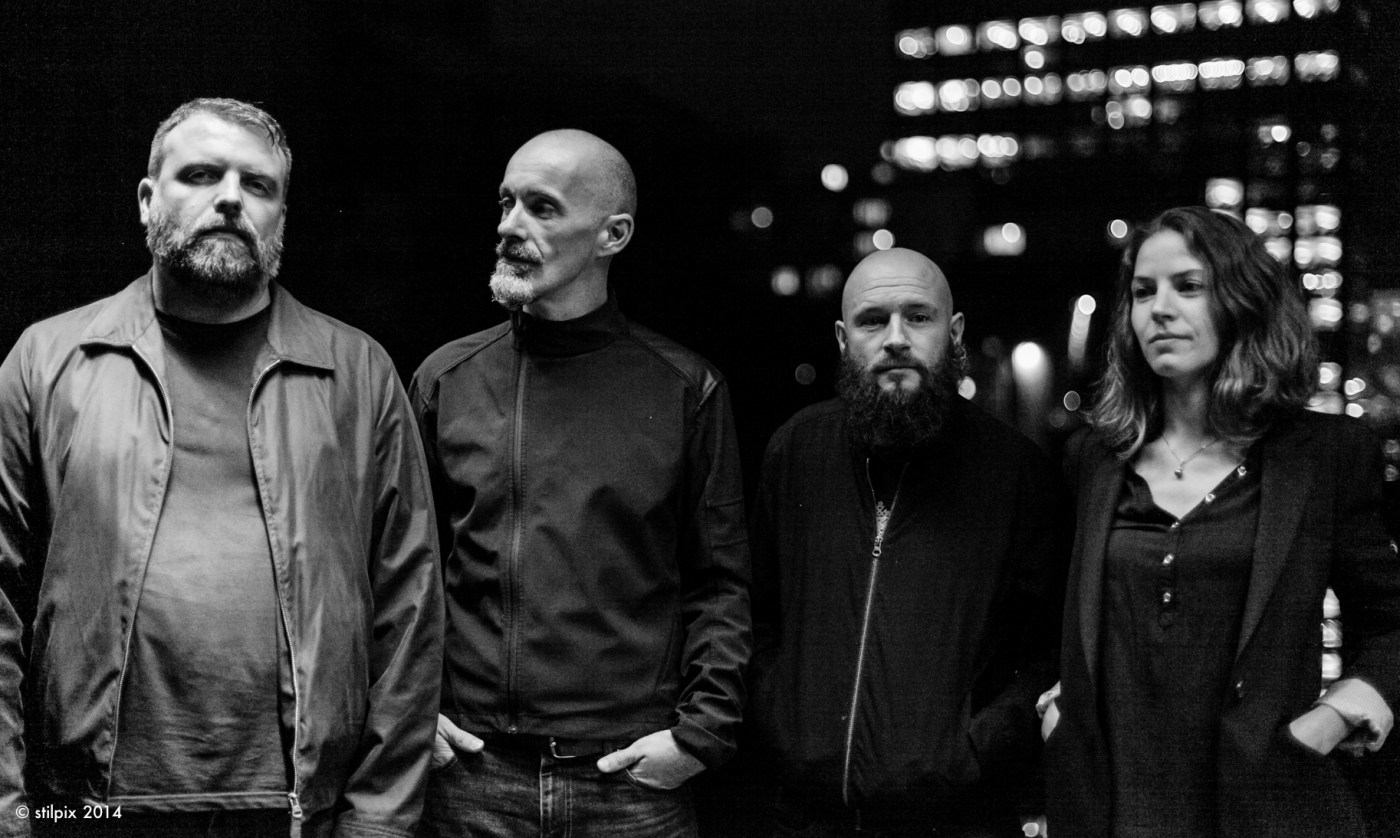
Fronted by singer and writer Brian Brannigan, A Lazarus Soul first spun-out from that number and – with various inputs and injections from another local doing God’s own work, guitarist and producer Joe Chester – issued a couple of sturdy if unspectacular elpees.
To my shame, I’d assumed that, like Lazarus himself, they’d died with their indie-kids’ kicks on after the release of their third album, ‘End of the Analogue Age’ back in 2014. And yet here we are, over a decade on, and A Lazarus Soul are one of the most compelling domestic acts working the seam. So where did it all go wrong?
I saw them earlier this year at Saint Patrick’s Cathedral in Dublin as part of a typically esoteric Tradfest line-up and I couldn’t believe how prescient they were. The venue was certainly a help in this regard: a customised stage in a large, consecrated and ornate space that didn’t feature a bar, smoking area or toilets. Without the distractions that de-rail far too many live shows – booze, mobile phones, general eejitry – ALS were just impossible to ignore.
In a packed church – an irony that won’t have been lost on them – they put on a typically visceral show, one of the most powerful I’ve seen in a while, pulling largely from their two strongest albums, ‘The D They Put Between the R and L’ [2019] and ‘No Flowers Grow in Cement Gardens’ released two years ago. However uneasily it sits with them, it feels as if they’ve finally come in from the margins and are no longer just hanging around.
It was the proselytising of Paul Page, the Whipping Boy guitarist and erstwhile blogger, that led me back in their direction. And indeed there are many similarities between both outfits, most notably in the unflinching intensity that underpins them and the lashed guitars that decorate some of their material. But ‘Last of the Analogue Age’ is still a curate’s egg of an album: some of it sounds like The Divine Comedy on ‘A Fanfare for the Comic Muse’, recorded when Neil Hannon was a callow shoe-gazer who couldn’t see too far beyond his fringe.
‘We are not what we know but what we are willing to learn’ is a line attributed to Mary Catherine Bateson, the American anthropologist and it’s a maxim that might help to explain the curious position in which A Lazarus Soul now find themselves. The band has outgrown its natural urges and has dramatically expanded its frame of critical reference for genuine impact. A testament to which is arguably one of its best-known songs, ‘The Black and Amber’.
That ballad takes its name from the famous Kilkenny-run pub and traditional All-Ireland final stop-off in Islandbridge in Dublin that, like many staunch, old-school Irish boozers, was sold off for development. That a venerable old folkie like Christy Moore opted to cover it on his recent album, ‘A Terrible Beauty’, is a reflection not just of the power of the song itself but of Brannigan’s standing as an astute documentarian trading in that last great taboo in Irish social and cultural life: class.
Moore has long been a champion of social justice and doesn’t tend to waste his time with fools. And so, his association with ‘The Black and Amber’ – which he performs without accompaniment – speaks to much more than simply the sum of the song’s parts: it is, to all intents, a benediction.
The distance travelled by A Lazarus Soul can only be accurately measured when set against Brannigan’s development as a vocalist and songwriter: the two are co-joined. Over a decade in which he’s become wholly comfortable with his own, unfiltered singing voice, he’s developed his writing in tandem.
Now infusing his songs with the ghosts of some of the great Irish ballad singers, ALS are nodding as frequently to Luke Kelly as it once would have done to Luke Haines. Given the recent frenzies generated by the likes of Lankum and Lisa O’Neill – both of them mine similar thematic conceits – is it this kind of authenticity that’s given A Lazarus Soul their relevance?
Nicknamed Lazarus by his mother, having survived a number of illnesses and surgeries as child, Brannigan is a fascinating character who, decades after he first hawked his wares around the fringes of the Dublin underground, now keenly observes the vagaries of life on the margins of a cash-rich, morally bankrupt society.
From ‘No Flowers Grow, ‘Factory Fada’ tells the story of a pair of classmates who, blackguarded and failed by state’s education system, both died before they were thirty years old. Elsewhere on that elpee, ‘The Dealers’ is its mighty companion piece telling, as it does, of a different Dublin generation: Bridie and Tessie, street traders from Dublin, are formidable women whose fortitude has seen them into the autumn of their lives. They dream now of seeing out their days in council houses with gardens Drumshambo in County Leitrim.
Its familiar turf. Backed by Julie Bienvenu on drums, another long-time indie stalwart, Anton Hegarty on bass guitar and propelled into a different orbit by Joe Chester, Brannigan has long dealt with weighty matter, even when his band is at its most upbeat. From ‘Last of the Analogue Age’, ‘Mercury Hit a High’ is a love-song with a sunny disposition set in summer – but with a dark curl to it. Love, our hero determines, ‘keeps the black dog away’. But what happens when that love is lost?
‘The older we get, the farther we see, the more we mean to each other, the more you mean to me’, sings Liam Ó Maonlaoí on ‘The Older We Get’, one of the stand-out cuts, among many, on Hothouse Flowers’ debut 1988 elpee, ‘People’. It’s a simple enough song, and Liam’s words – a paean to an older generation, possibly his parents – are uncomplicated and direct. Much of the band’s canon from this phase of its career is characterised like this.
A record that resonated commercially on its release, I’m not sure it gets the critical plaudits it deserves, especially on its own doorstep. But it’s a record I’ve returned to quite a bit over the last while and, every time I do so, I find more and more to admire about it. I’m not suggesting that ‘People’ is a classic record by any means, but isn’t that, at its core, what defines classic records?
Decades later, the same can be said for A Lazarus Soul, and in particular those two most recent albums, the devil in which in both cases is in the detail. There’s a bravery coursing through Brannigan’s songs that sets them apart and an authenticity that he backs up with lived experience: it gives the band a sharp, congenital edge.
At some point today I’ll root out one of Philip’s favourite songs, ‘Fall on Me’ by REM, and give it a run: it’s become a tradition at this stage and it’s how a couple of us chose to mark the day.
And I’ll think back to those numerous conversations on the railings on Saint Mary’s Road and wonder what he’d have made of A Lazarus Soul and ‘The Black and Amber’? And Christy Moore’s version? And about the scolding he’d have given me for even bringing Hothouse Flowers into any self-respecting critical conversation.
What prints I leave?
Indeed.


Leave a comment