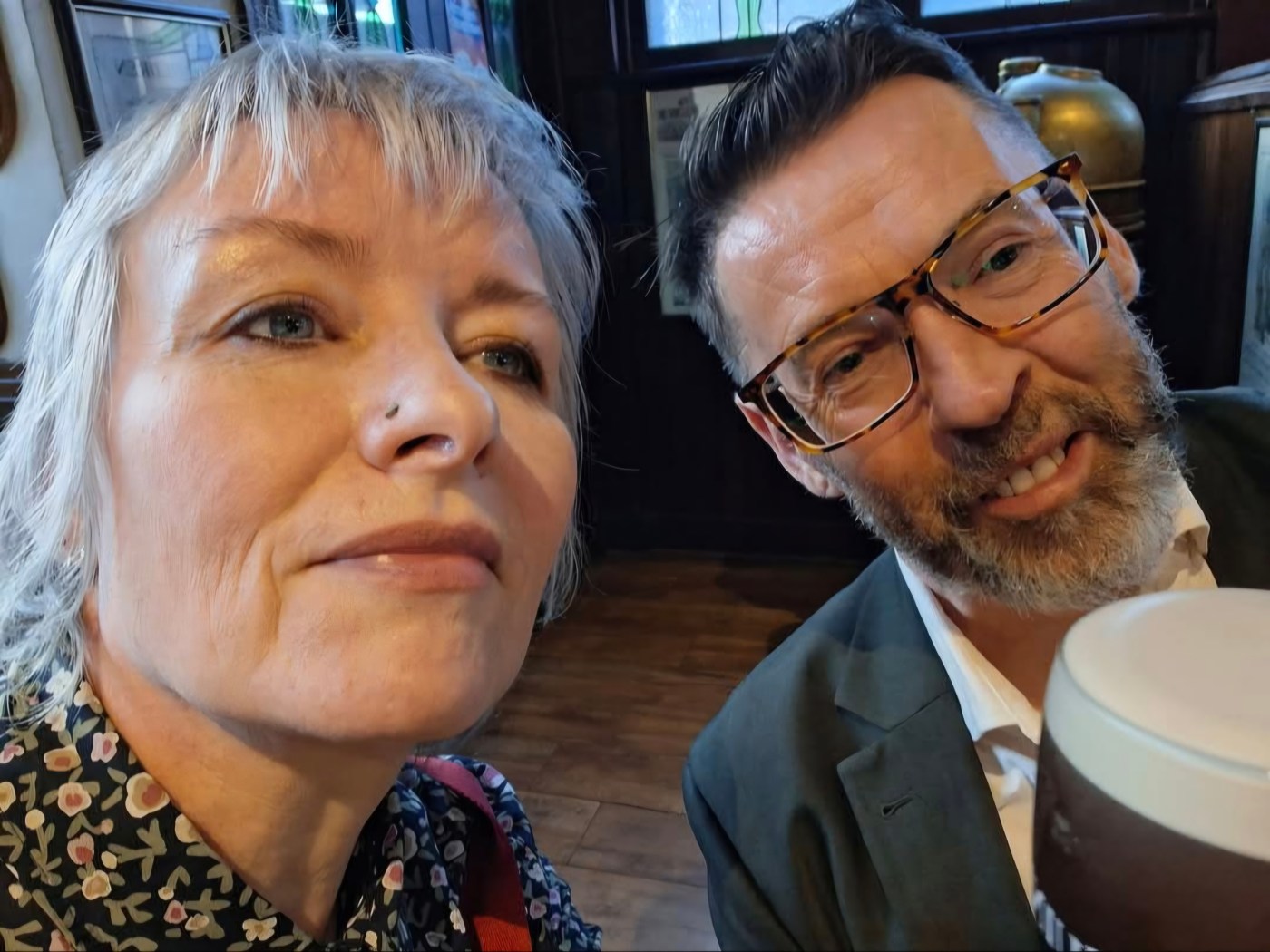
Guest post by Kieran Cunningham
There was that windrush of voices rising, blurring into a hot mess, that made it easy to be distracted. I was standing in a marquee set up for the Gleann Cholm Cille Agricultural Show – on the edge of one conversation, but tuned into another.
It was one taking place behind me, and I was the subject. “That man was opened.” The loudest whisper.
It was August, 2023, and I was two months on from open heart surgery. Within 18 months, I’d be back under the knife as an aggressive and rare cancer had to be cut away and then there was a trip on the chemo/radio carousel. On my first day back at work, I was called to a meeting announcing multiple redundancies. Within a month, I was out the door after nearly 30 years.
I’m 59 years old and nobody who reaches that age does so untouched, undamaged. I lost a brother, lost a baby boy who was named after my brother, lost too many friends to count. Lost a pensionable job.
Maybe that leaves some men opened, but it’s left me shuttered and closed. To unlock the door, I’ll need help, and that help is coming.
This, though, is a week to get through. On Wednesday, I will have a scan to see if my cancer has returned. On Friday, it will be 30 years since my brother, Paddy, breathed his last in a London hospital. He was 26 years old. A rare and aggressive cancer – different to mine – stole his life.
When he took his last breath, I was smoking my first cigarette in years with a friend in the hospital car park. I remember going back to Paddy’s room and tumbling to the floor, howling in despair and grief. My uncle and godfather, Jamie, was there and held me in his carpenters’ grip.
I haven’t cried since that night of July 3, 1996. Not when our son, Paddy, died. Not at the other desperately sad funerals of friends. Not during the grind of cancer treatment.
But something strange has happened in recent months. Various medications that I have been put on have combined to produce the most vivid of dreams and, again and again, I dream of the summer of 1996. A summer spent in Gleann Cholm Cille in a caravan – the family home was housing Irish language students. A summer adrift on late nights and long days and a fierce need for connection.
To many, the summer of ’96 is about the fake gloss of Britpop, or Dagenham Dave’s England team convinced it was coming home, or the curious case of an Irish swimmer in Atlanta, or Mayo finding a new way to lose. To me, it conjures up Altan and the way they might move you.
Whether it was the stillness of Mairéad Ní Mhaonaigh quieting the ballroom of the Glenbay Hotel with the exquisite ‘An Mhaighdean Mhara’ or the twin fiddles of herself and Ciarán Tourish warping the floorboards with exhilarating tunes that mixed Ireland and Scotland with a dash of Greece.
That summer seemed to have a musical undertow, tunes where you didn’t expect to find them. I’d walk down the road and pass The Weaver’s house, and hear him in advance. When I was very small, we had a loom in the house – many did at the time – but The Weaver was now one of a dwindling band.
Even if the rugs didn’t sell, he’d still go out to his shed, perch on the bench and weave every day. Maybe it was the seduction of the hypnotic. That marriage of movement and sound, and the piece of tweed slowly taking shape.
Maybe it was even the allure of the language of weaving. The warp and the weft. The shuttles. The loom itself. The metre and the rhythm, the beauty and the beat. A full body experience. Total concentration. Both hands working, feet driving the pedals. It had its own music. It would have me tapping out its beat as I walked.
Beat has another meaning. Nearly 30 years on, memory takes me back to a more recent morning where I was beaten, all ends up. Wasted and wounded, Kate Bush was in my head, telling me that just being alive can really hurt. At least I had a room with a view but, on these interminable January days, all was grey. All the damned seagulls were fallen angels. Seconds were minutes, minutes were hours, hours were days. You know the drill. I’d press repeat and Kate would start ‘Moments of Pleasure’ again.
Peigí sat by the hospital bed, the air tender and fragile between us. It was only two weeks since we sat in front of the gentlest of consultants who told me I had cancer and would be fast-tracked for surgery.
Part of my body had since been lopped off. Ashes where once was fire. There would be chemo and radio to come. For now, it was about recovery and cursing seagulls – for their freedom, maybe? – and trying to identify the hurling accents of nurses as they chatted when changing shifts.
There is something no-one tells you about cancer. You will be battered into submission by cliché. I was never in a battle, truth be told. I’m not brave or a fighter or a warrior. Still, I had so many bicep emojis sent my way that it’s like falling into a barrel of McGeeneys.
Spare me the warrior guff. It had nothing to do with the reality of lying in a bed, doing what I was told, wondering when I should empty the piss bag, and hoping they’d let me disappear into the haze of morphine or Oxycodone soon.
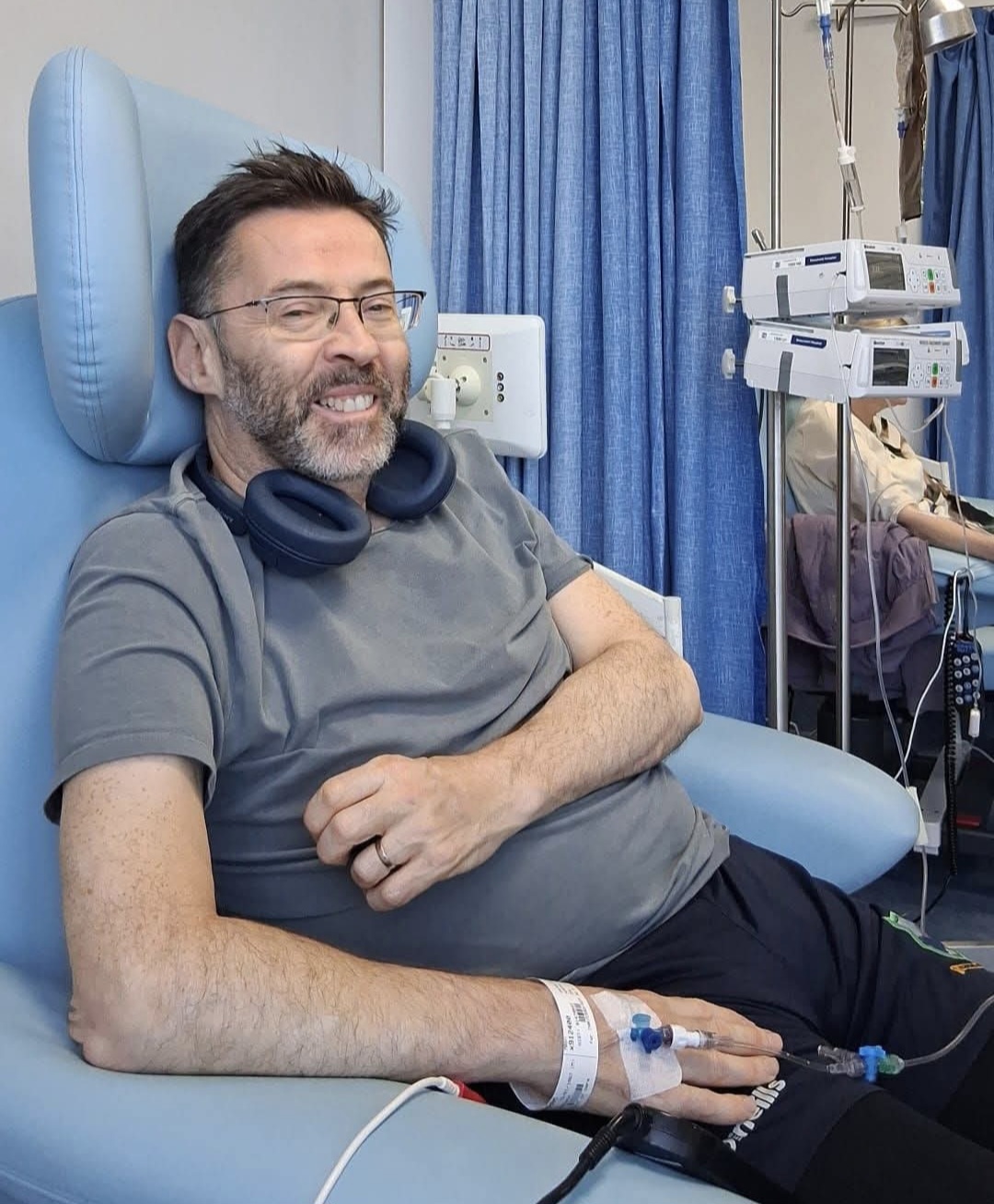
Sometimes I’d walk the corridor. It took 50 steps door to door. It took the same on the way back. I checked. On one particular walk, I heard a man talking in the next ward and stopped to eavesdrop. He was leaning forward in his bed to make himself heard to the man opposite. He was talking of showbands and their faithful departed. “Butch Moore is dead. Brendan Bowyer is dead. Larry Cunningham is gone too. Dickie Rock is dead.”
The dead never leave us. The research into losing a sibling details many instances where the survivors feel they have to do the living for those they lost. There’s something to that.
When you lose someone after a long illness, often your memories of them are dominated by the days and nights of struggle. Life before cancer seems blurred at the edges.
But, even when the disease bit Paddy, there were times of fun and laughter. A night in the Mean Fiddler in Harlesden where he danced himself silly to a Madness tribute act – the morphine in his system giving him the energy to do so.
In my own morphine delirium in Beaumont, Paddy was on my mind, and the clearest memories of him are from childhood days. There’s a Seamus Heaney poem where he remembers a family sofa as a train and how they’d ape the piston drive and the chug, chug, chug of those they’d see on westerns.
To us, the sofa was a cinema, a theatre, often a battleground of sharp elbows and sensitive ribs. But sometimes it was a peaceful place. Especially when Robin of Sherwood came on.
Clannad, from up the road, sang the theme song and we loved the bit about the ‘hooded man’. What kid didn’t see mystery in a hooded man? Paddy wanted to be Robin Hood. What kind of man would he have become? A good man, that’s all I know.
The tragedy of our son, Paddy, is that he never got to live before leaving us. That leaves a deep wound. Grief as a felt absence. His cremation was in Glasnevin Cemetery and we chose Peter Gabriel’s ‘Solsbury Hill’ for his farewell – ”you can keep my things, they’ve come to take me home.” The most moving of lines and it always stills me, but no tears ever come.
Like any family with mileage on the clock, we have endured plenty. Nothing for it but to tighten the circle with Seán and Sé and Mae ever closer.
What is Peigí going through? Sé? Seán and Mae? A family gets cancer, not just the person with the diagnosis.
Major surgeries and serious illnesses don’t cure you of sweating the small stuff. Yeah, I know all that jazz about enjoying yourself, that it’s later than you think, but there is no cure for human flaws. Doctors don’t prescribe medication for everyday crankiness.
It is music that sustains me, and no Irish writer got to its truth better than the late Belfast poet Ciaran Carson in his wonderful book ‘Last Night’s Fun’. Each chapter is given the name of a tune; the book framed in the shape of a night’s session.
There are diversions on the wonders of fried breakfasts, on the exquisite sorcery of hurling, on the colour of old cigarette packets. To Carson, music is a way of ”renegotiating lost time”.
Too much time has been lost, I can’t deny that. How to make the best of what is left. That is the question. There is no easy answer.
The strangest of consolations is that both my parents have dementia, and they’re oblivious to the drama of recent years. Speech is beyond my father, Francie, now. My mother, Kal, still has her moments. They share a room in a nursing home outside Killybegs and, on one visit, I mentioned a song her father, Patrick Heekin, used to sing.
We knew it as ‘The Bark and the Tree’. Its correct title is ‘A Nobleman’s Wedding’. It dates from Cornwall in the 18th century and is part of the tradition in Nova Scotia, the Appalachian Mountains, Scotland Wales and Ireland as well as England.
How did such a song become so embedded that it became part of the Donegal vernacular in the 1940s? Heart mysteries there. That day in the nursing home, Kal’s eyes lit up and she sang a word perfect version. A half smile crossed my father’s face. It’s the way I think of Francie and Kal. The bark and the tree.
The Irish word for cancer comes into my head. Ailse. Now that was a mistake. Far too pretty a word for something so monstrous. I go back to Kate. Press play and close my eyes. There is beauty even in broken places. Good singers start low. Where did I hear that? There’s something to it.
This year began like any other. Alive with bite and noise and possibility. But all any of us know is that everything can change in an instant.
Nothing to be done but to let go, to let fly.
Falling free as oak, as feather.


Leave a Reply